
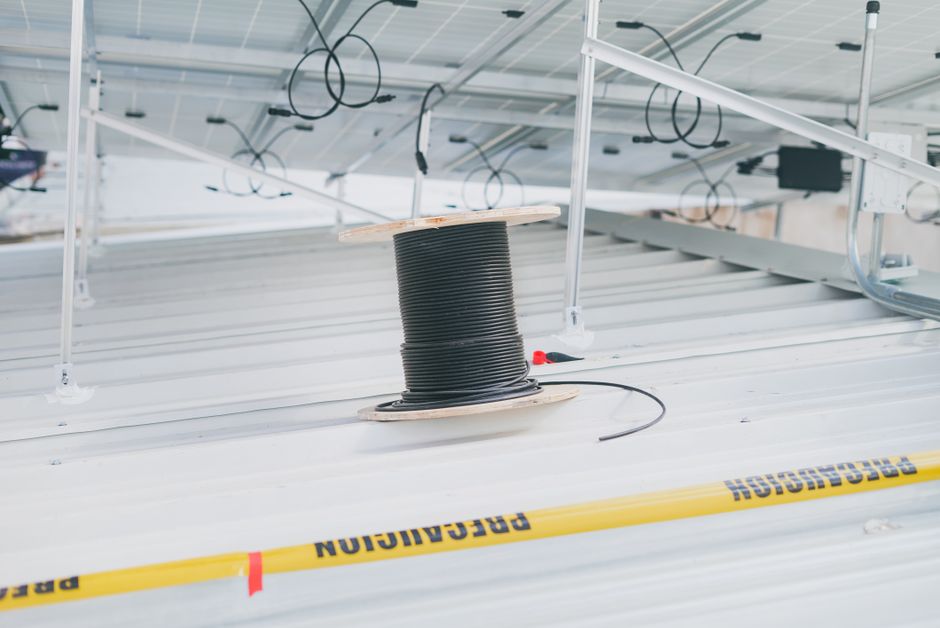
Cable is the least glamorous line on a solar quote and one of the most important to get right. It’s tempting to think wire is just wire — but solar cable is deliberately chosen and sized by calculation, for good reasons of both safety and performance. Undersize it and you waste the very power your panels worked to generate, or worse, create a fire risk. This is the more technical companion to the cabling basics — a look at how cable is actually specified, and why it’s electrician’s work rather than guesswork.
Why solar cable isn’t ordinary wire
The DC cabling running from your panels to the inverter does a hard job in a harsh place: it sits on a roof, in full sun, for 25 years, carrying high-voltage direct current. Ordinary house wiring isn’t built for that. Proper solar DC cable is:
- UV-resistant, so years of sunlight don’t degrade the insulation.
- Double-insulated, for safety at the high DC voltages a string can reach.
- Rated for the temperature and voltage of a rooftop array.
The AC cabling from the inverter to your switchboard is wired to the standard rules like any other circuit, but the DC side is solar-specific — and it’s where careful sizing matters most.
The two things cable is sized for
Cable sizing isn’t a guess; it’s a calculation balancing two separate requirements, and both must be satisfied.
1. Current-carrying capacity (safety)
Every cable can only carry so much current before it overheats. Push too much through a too-thin cable and the insulation heats up — a genuine fire risk. The required size depends on the current the array can produce, plus a margin for conditions: a cable on a baking-hot roof, bunched with others, can safely carry less than the same cable in free air. So the electrician sizes for the worst-case current in the worst-case conditions, with safety margin built in. This is the non-negotiable, safety-critical criterion.
2. Voltage drop (performance)
The second criterion is about not wasting power. As current flows along a cable, a little energy is lost as heat — and the longer and thinner the cable, the bigger that loss, called voltage drop. Too much voltage drop means some of the electricity your panels generated never reaches the inverter; it’s simply lost on the journey. Standards set a limit on acceptable voltage drop (commonly a small percentage), so the cable is sized large enough — especially on long runs — to keep those losses low. This is why a panel array a long way from the inverter may need thicker cable than a short run.
The final cable size is whichever of these two criteria demands the bigger cable. Both have to be met.
Why this is a calculation, not a guess
Because both criteria depend on specifics — the array’s current, the run length, the rooftop conditions, the standard’s limits — cable sizing is a proper calculation an electrician performs for your system, governed by the wiring rules (AS/NZS 3000) and the solar array standard (AS/NZS 5033). A competent installer sizes cable correctly as a matter of course; a cut-price one might use undersized cable to save a few dollars, which quietly costs you output for 25 years or, at worst, creates a hazard. It’s one of the hidden places where install quality really shows.
The connectors matter too
Cable is only as good as its joints. The DC connectors between panels (commonly MC4-type) must be matched and properly crimped — mismatched or loose connectors create high-resistance hot spots that are a known fire point. Correct cable and correct connectors together make a safe, efficient DC circuit.
The verdict
Solar cable is purpose-built — UV-resistant, double-insulated DC cable — and sized by calculation against two criteria: it must carry the current safely without overheating, and keep voltage drop low so you don’t lose generated power on long runs. The bigger of those two requirements sets the size. It’s governed by standards and done by a registered electrician — not guessed — which is exactly why proper cable spec is one of the quiet markers of a quality install versus a cheap one.
Get a free assessment and we’ll make sure your system is spec’d and installed properly.
Sources: Cable current-rating and voltage-drop requirements per AS/NZS 3000 and AS/NZS 5033; Standards NZ. Cable sizing is prescribed electrical work for a registered electrician.