
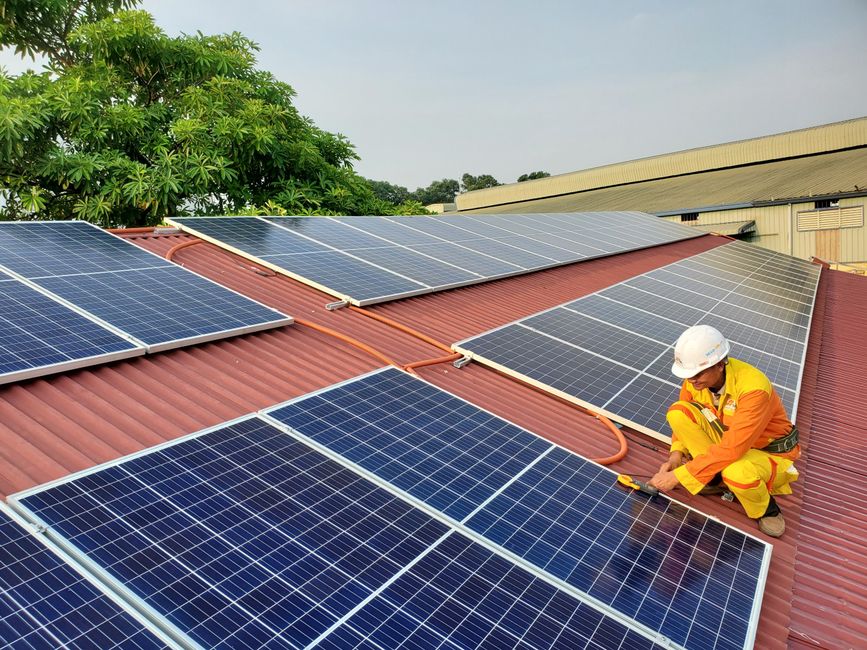
When people compare solar quotes, they fixate on the panels and the inverter and barely give a thought to the brackets holding the whole thing onto the roof. That’s a mistake. The mounting system — or “racking” — is what keeps a quarter-tonne of glass and aluminium attached to your house through 25 years of New Zealand wind, rain, and storms. Get it right and you never think about it again. Get it wrong and you’re looking at leaks, or in the worst case panels lifting in a gale. It’s genuinely structural work, not an afterthought, and it’s worth knowing what’s up there.
What the mounting system is made of
The racking is a kit of parts that work together to fix panels to your roof and keep them there:
- Roof attachments (feet). These anchor into the actual roof structure — the rafters or purlins underneath — not just the surface. They’re what transfers the load into the building.
- Rails. Aluminium rails run across the attachments to form a level framework for the panels to sit on.
- Clamps. Mid-clamps and end-clamps grip the panel frames and hold them down onto the rails.
- Flashing and seals. Every point where a fixing penetrates the roof is a potential leak, so flashings and seals make each penetration watertight.
It looks simple, and conceptually it is — but every one of those parts is doing a real job, and the weakest one sets the safety of the whole array.
Why it’s structural, not decorative
Two forces make mounting far more than a set of brackets, and both matter especially in New Zealand.
Wind uplift
This is the big one. New Zealand has serious high-wind zones, and wind doesn’t just push on a panel array — it lifts it. As air flows over a roof it creates suction, and a poorly anchored array can peel up or tear off in a strong enough storm. Good racking is designed to the wind loadings for your specific site and roof, with the right number and spacing of attachments to resist that uplift. Under-specified mounting — too few fixings, or feet not properly tied into the structure — is exactly what fails in a gale. This is invisible in a quote but critical in a storm.
Weathertightness
Every fixing you drive through a roof is a hole in your home’s weather envelope. Done properly, with correct flashing and sealing, those penetrations stay watertight for the life of the system. Done carelessly, they’re slow leaks that you may not notice until there’s damage in the ceiling below. On a long-lived asset, the quality of the sealing work is as important as the strength of the fixing.
Roof type changes everything
There’s no single mounting method, because New Zealand roofs vary so much, and each needs a different approach:
- Corrugated steel (the classic Kiwi roof) uses fixings into the purlins with sealing washers.
- Tile roofs need special tile hooks or replacement tiles so the structure isn’t cracked and the roof stays weathertight.
- Flat or membrane roofs use tilt frames to angle the panels, and have to be sealed and ballasted carefully to avoid puncturing the membrane.
A competent installer chooses and specifies the right mounting for your roof type and wind zone. It’s one of the clearest places where local experience and workmanship show up.
The verdict
Good racking is completely invisible — it holds your panels rock-steady and bone-dry for decades, and you forget it’s there. Poor racking lifts, rattles, or leaks, and any of those can be expensive. Because mounting is structural work that has to handle real New Zealand wind and stay watertight through every storm, it’s one of the strongest reasons to choose your installer on the quality of their workmanship rather than the lowest price. The panels make the headlines; the racking is what keeps them on the roof.
Go deeper: Solar mounting and racking
Sources: Wind-loading and weathertightness requirements per New Zealand building and solar installation standards; roof-type mounting methods per industry guidance. Mounting design should always suit the specific roof and wind zone.