
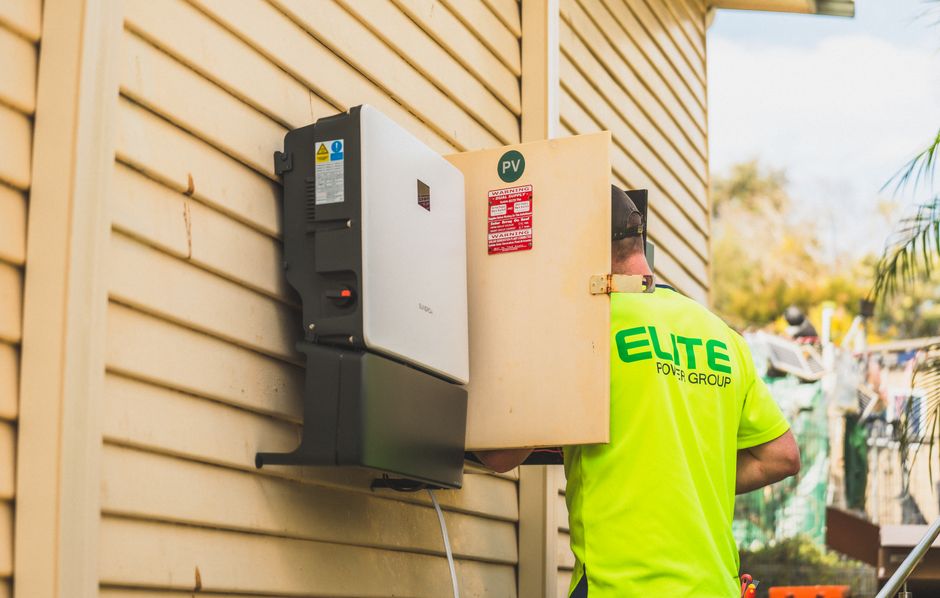
Of all the parts of a solar system, the inverter is the one people understand least — partly because it’s tucked away on a wall in the garage, and partly because its job sounds abstract. But it’s worth getting your head around, because the inverter is the hardest-working component you own, the one that quietly determines how well your panels perform, and usually the first part you’ll ever have to replace. Here’s what it actually is and why your solar system can’t work without it.
The core job: DC to AC
Start with a basic fact about electricity. There are two kinds. Direct current (DC) flows steadily in one direction — it’s what a battery or a solar cell produces. Alternating current (AC) rapidly switches back and forth — it’s what comes out of your wall sockets and runs the national grid.
Your solar panels produce DC. But your home’s wiring, every appliance you own, and the grid itself all run on AC. So the raw power coming off your roof is, in its native form, useless to your house — it’s the wrong kind of electricity. The inverter’s fundamental job is to convert that DC into AC, continuously and instantly, so your solar power can actually run your home and feed the grid. Without it, you’d have panels making electricity that nothing in your house could use.
What it does beyond converting
If the inverter only flipped DC to AC it would still be essential, but it actually does several other important jobs at the same time — which is why it earns the title “brain of the system”:
- It squeezes the most out of your panels. Sunlight changes constantly — a passing cloud, the angle of the sun, the time of day. The inverter continuously hunts for the operating point that pulls maximum power from the panels as conditions shift. (The technical name is maximum power point tracking, or MPPT.)
- It keeps the grid safe. A grid-connected inverter constantly monitors the grid, and if the power goes out it automatically shuts down — so your system can’t feed electricity into lines that workers might be repairing. This safety feature (called anti-islanding) is also why a standard solar system goes dark in a blackout unless you’ve added a battery.
- It reports what’s happening. The inverter tracks your generation and feeds it to an app or web portal, so you can see what your system is producing and catch a problem early.
Why it matters so much
Two things make the inverter worth real attention when you compare quotes:
- It’s the part you’re most likely to replace. Panels routinely last 25-plus years, but the central type of inverter typically lasts 10–15 years. So over the life of a system you should budget for one replacement, at roughly $1,500–$3,000. A cheap quote built around a budget inverter can cost you more in the long run.
- It shapes how your panels perform. On a roof with any shade, the type and quality of the inverter has a big effect on how much power you actually harvest. The right choice depends on your roof.
A word on efficiency
Modern inverters are around 96–98% efficient, meaning they waste very little of the power passing through them. Because the good units are all clustered up at that high efficiency, there’s little point obsessing over a fraction of a percent. Reliability, the warranty, the brand’s local support, and how well it handles shade matter far more than the efficiency figure on the spec sheet.
Which type should you get?
There are three broad types — string inverters, microinverters, and hybrid (battery-ready) inverters — and the right one depends on your roof’s shade and whether you want a battery. That’s a decision in its own right, so rather than repeat it here, see inverters — the basics for how to choose between them.
The verdict
The inverter is the translator that turns your panels’ DC into the AC your home can actually use — and along the way it maximises your output, keeps the grid safe, and reports your generation. It’s the brain of the system and the component most likely to need replacing, so it deserves real attention in a quote: ask what type it is, what brand, and how long the warranty runs. Don’t let it be the afterthought it so often is.
Get a free assessment and we’ll match the inverter type to your roof and plans.
Sources: Inverter function, efficiency, lifespan, and warranty data per 2026 industry references. Figures vary by product and installer.