
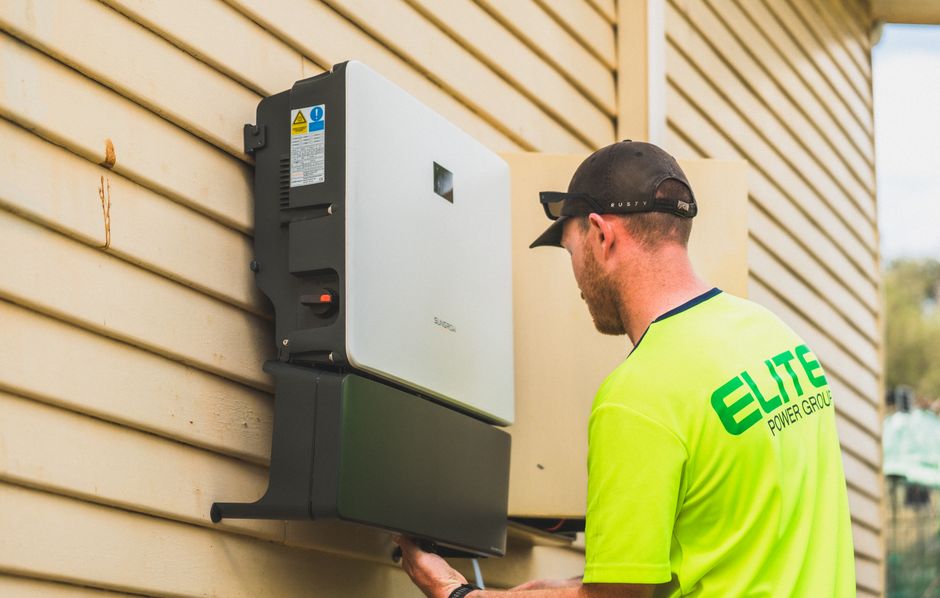
Panels get all the attention, but the inverter is the component that does the real work, minute to minute, and it shapes both your system’s performance and your long-term costs. If the panels are the muscle of a solar system, the inverter is the brain. Understanding what it does — and the three different ways it can be configured — will help you read a quote and avoid the wrong setup for your roof.
What an inverter actually does
Your panels produce direct current (DC). Your home, your appliances, and the national grid all run on alternating current (AC). The inverter sits between them and converts DC into AC — but it does far more than that one job. It also:
- Manages the system’s behaviour, constantly adjusting to pull the most power from the panels as light conditions change (a function called maximum power point tracking).
- Handles grid safety — a grid-connected inverter automatically disconnects during a power cut, so it can’t feed electricity into lines that workers may be repairing.
- Reports your generation, usually through an app or web portal, so you can see what the system is producing and spot problems early.
Modern inverters are around 96–98% efficient, so the differences between good units are small. Reliability, warranty, and how a unit handles shade matter far more than chasing the last fraction of a percent.
The three types
This is the decision that actually matters, because it determines how your system copes with shade and what you’ll eventually replace.
String inverters
All your panels are wired together into one or more “strings” that feed a single central inverter. This is the cheapest and most common setup. The catch: panels in a string perform together, so if one panel is shaded or underperforming it can drag down the whole string’s output. String inverters suit simple, unshaded roofs and typically last 10–15 years.
Microinverters
Instead of one central unit, a tiny inverter sits on each panel, so every panel performs independently. Shade or a fault on one panel no longer affects the others, and you get panel-level monitoring. Microinverters usually carry 25-year warranties matching the panels, but they cost more upfront. They shine on complex, shaded, or multi-orientation roofs.
Hybrid inverters
A hybrid is a string inverter that can also charge and draw from a battery. If you have a battery now, or think you’ll add one later, a hybrid inverter is usually the sensible choice — it future-proofs the system without needing a separate battery inverter down the track. (There’s also a useful middle option — power optimisers — small devices fitted to each panel and paired with a string inverter, giving much of the per-panel benefit of microinverters at lower cost.)
Why the inverter matters for your wallet
The inverter is the component you’re most likely to replace. A string inverter often needs swapping once during a system’s life, at roughly $1,500–$3,000. Microinverters usually don’t need replacing — you’ve paid for that longevity in the higher upfront price. Either way, factor this into your comparison: a slightly cheaper system with a short-lived budget inverter can cost more over 25 years than a dearer one with a better unit.
What to check on a quote
Because the inverter is so central, it’s worth a few specific questions:
- Which type, and why? A good installer can explain why a string, micro, or optimiser setup suits your roof and its shade.
- What brand and warranty? Look for a reputable brand with New Zealand support and a clear warranty term — and check whether it’s 5, 10, or more years.
- Is it sized sensibly to the array? Inverters are rated in kW; the inverter should match your panel array, not be quietly undersized to save money in a way that clips your output on sunny days.
- Is it battery-ready? If a battery is even a maybe, a hybrid inverter now saves money and rework later.
How to choose
- Simple, sunny roof: a quality string inverter is the cost-effective choice.
- Shaded or multi-angle roof: microinverters or power optimisers handle the shade far better.
- Battery now or later: a hybrid inverter keeps your options open.
The verdict
Don’t overlook the inverter when comparing quotes — ask which one is included, what type, and what its warranty is. It’s the brain of your system, the part most likely to be replaced, and the component that most affects how your panels perform on anything but a perfectly sunny roof. For a deeper comparison, see string, micro, or optimisers.
Sources: Inverter type, efficiency, lifespan, and warranty data (2026 industry references). Figures vary by product and installer.