
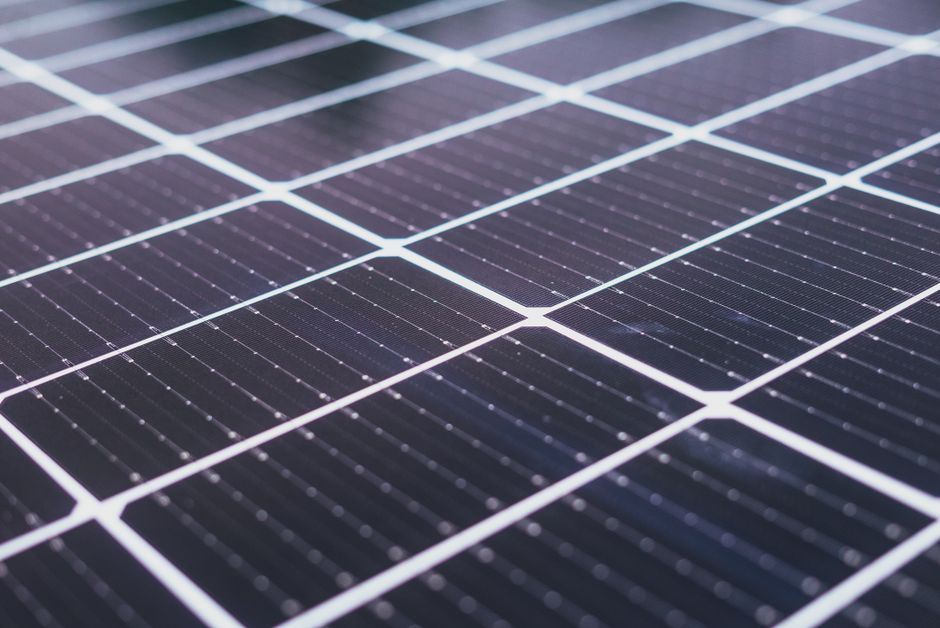
The panels are the part of a solar system everyone pictures — the flat rectangles on the roof. Their job is beautifully simple: turn sunlight into electricity, silently, with no moving parts, for decades. But while the physics is long settled, choosing panels is where a lot of buyers get tangled in spec sheets that matter far less than they’re told. This guide explains how a panel actually works, the types you’ll come across, the handful of numbers genuinely worth caring about, and — the part most guides skip — what really drives how much power you’ll get.
How a solar panel works
A panel is made up of many solar cells, almost always silicon. When light hits a cell it knocks electrons loose and creates a flow of direct current (DC) electricity. Each cell produces only a small voltage, so they’re wired together inside the panel, and panels are wired together into an array on your roof. That array feeds an inverter, which converts the DC into the alternating current (AC) your home and the grid actually use.
There’s no combustion, no fuel, and nothing that wears out the way an engine does — which is why panels routinely outlast their 25-year warranties. On a sunny day your array quietly runs the house and sends the surplus to the grid; on a dull one it produces less and you draw the difference from the grid as normal. That’s the whole cycle, repeating every day for decades.
The one number that matters most: wattage
A panel’s headline spec is its power rating in watts — a modern residential panel is typically 400–450 W. Add up all the panels and you get your system size in kilowatts (kW), the number everything else is quoted against. A typical New Zealand family system is around 5–6.6 kW, made up of roughly a dozen-plus panels. Bigger isn’t automatically better: the right size is the one whose generation you can actually use, not the most you can cram onto the roof.
The types of panel
For home roofs the field has narrowed to essentially one option, but it helps to know the landscape:
- Monocrystalline — made from single-crystal silicon, these are the most efficient mainstream panels (roughly 19–22% efficiency) and now dominate residential installs. They perform better in low light and need less roof space for the same output.
- Polycrystalline — made from multiple silicon crystals, slightly cheaper and slightly less efficient. Once common, now largely displaced as monocrystalline prices have fallen.
- Thin-film — flexible and cheap per watt but much less efficient, so it needs far more space. Mostly used in commercial or specialist applications, rarely on home roofs.
In practice you’ll almost certainly be quoted monocrystalline panels, so the chemistry decision is largely made for you.
What actually matters when choosing
Since you’ll get monocrystalline either way, the real decision is about quality and who stands behind it:
- Brand reputation (“Tier 1”). This refers to a manufacturer’s scale and bankability rather than a guarantee of quality on its own, but it’s a sensible filter — avoid unknown off-brands that may not be around to honour a warranty.
- Warranties — and there are two. The product warranty covers defects (look for 12–25 years), while the performance warranty guarantees the panel still produces a minimum share of its rated output over time (typically 80–92% at year 25).
- Degradation rate. Good panels lose only about 0.3–0.5% of output a year; premium ones as little as 0.25%. That slow fade is why a 25-year-old panel still produces strongly.
- Local support. A warranty is only as good as the company honouring it, so favour brands with a real New Zealand presence.
What really drives how much power you get
Here’s the part the spec sheet won’t tell you: a panel’s rating is measured in ideal lab conditions, and your real-world output depends far more on how and where it’s installed than on a point or two of efficiency. The big factors:
- Direction and tilt. North-facing at a sensible pitch is ideal in New Zealand; east and west still work, with the peak shifted earlier or later in the day. South-facing is the weak spot.
- Shade. This is the big one. Even partial shade — a chimney, an aerial, a tree branch — can cut output disproportionately, because a shaded panel can drag down others wired with it. A clear roof beats a high-efficiency panel in the shade every time.
- Temperature. Panels actually lose a little efficiency when they get very hot, which is why ventilation behind them and a sensible install matter.
- Region and season. The sunny north generates more per kW than the deep south, and every roof makes far more on a long summer day than in grey midwinter.
Notice that none of these is the panel brand. The single biggest lever on real output isn’t the panel at all — it’s the installer who sites and wires it well.
What not to obsess over
Don’t agonise over a point or two of efficiency — it mainly matters if your roof space is tight. And don’t chase the cheapest price per panel: a bargain panel that degrades fast, or whose warranty can’t be claimed, costs more across 25 years.
The verdict
Panels are the durable, low-drama heart of a solar system. You’ll almost certainly get monocrystalline, so put your energy into a reputable brand, solid product and performance warranties, a good degradation rate, and — above all — a quality installer who sites them to avoid shade and face the sun. Get those right and the panels themselves will quietly outlast their warranty. For choosing between brands, see how to choose solar panels in NZ.
Sources: Panel technology, efficiency, and warranty data (2026 industry references); panel degradation per long-term field studies; output factors per EECA. Figures vary by panel and site.