
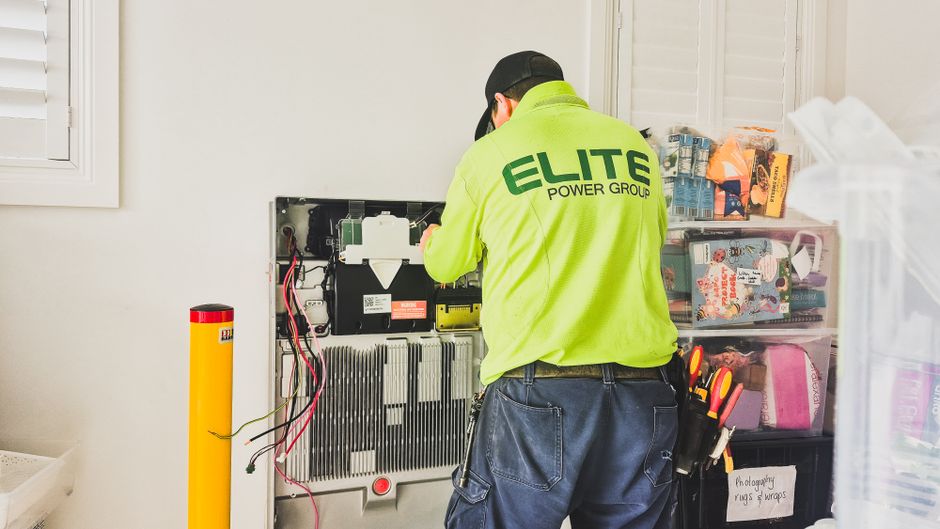
A home battery is the single most-asked-about and most-oversold part of a solar system. It’s also the most expensive add-on, so it’s worth understanding properly before a salesperson talks you into one — or out of one. In plain terms, a battery’s job is to store the solar power your panels make during the day so you can use it after the sun goes down. That one shift — using your own sunshine at night instead of buying expensive grid power — is the whole value proposition. Here’s how it works, what it costs, and whether it’s actually worth it for your home.
The problem a battery solves
Solar panels make the most power in the middle of the day, which is often exactly when a typical household is using the least — everyone’s at work or school. Without a battery, that midday surplus flows out to the grid, and your retailer pays you a low export rate for it (often around 10c/kWh). Then in the evening, when everyone’s home cooking, heating, and watching TV, your panels have wound down and you buy that power back from the grid at the full retail rate — around 39c/kWh.
See the mismatch? You’re selling cheap and buying dear, all in the same day. A battery fixes that timing problem. It captures the midday surplus, holds onto it, and releases it in the evening — so instead of exporting at 10c and re-buying at 39c, you simply use your own power. A battery is, in essence, a time machine for electricity.
What a battery actually gives you
Higher self-consumption
This is the financial heart of it. Without storage, a typical home self-consumes only about 30–50% of its solar. A battery can lift that to roughly 70–90%, because the evening usage that used to come from the grid now comes from stored sunshine. More self-consumption means more of your solar is worth the full 39c rather than the 10c export rate.
Backup power in an outage
Many — though not all — battery setups can keep essential circuits running during a power cut. This matters more than people expect: a standard grid-tied solar system shuts off in a blackout for the safety of line workers, so without a battery, solar alone won’t keep your lights on in an outage. A battery with backup capability changes that, which is genuinely valuable if you’re in an area prone to cuts.
Evening independence
There’s a less tangible benefit too: running your house on your own stored power in the evening, insulated from grid prices and peak-time charges. As time-of-use pricing spreads under the 2026 reforms, the ability to avoid buying at the expensive evening peak becomes worth more.
The catch: cost
Here’s the honest downside. A home battery is the biggest single add-on in a solar project — typically around $9,000–$14,000 depending on capacity and brand. That often comes close to doubling the cost of a solar installation. Because of that, a battery lengthens your overall payback rather than shortening it — you’re spending a lot to shift power by a few hours and to gain backup. The savings are real, but they rarely repay the battery as quickly as the panels repay themselves. So a battery is partly a financial decision and partly a lifestyle one (backup, independence), and it pays to be clear about which you’re really buying.
Sizing a battery
A common mistake is sizing a battery to your whole day’s usage. You don’t need to — the panels cover the daytime directly. A battery only has to cover your evening and overnight consumption, from when the sun drops until it rises again. For most New Zealand homes, that’s a single battery of around 10 kWh, which comfortably handles a typical evening of cooking, heating, and lights. Going much bigger usually means paying for capacity you’ll rarely fully use.
You can start without one
One genuinely reassuring point: you don’t have to decide on a battery now. Solar and storage are separate purchases, and many homes fit panels first, live with them for a while to learn their real usage, then add a battery later — especially if they choose a hybrid inverter up front, which is “battery-ready” and saves rewiring down the track. If a battery isn’t clearly worth it for you today, installing solar now and keeping the option open is a perfectly sound plan.
So — do you need one?
A battery makes most sense if you’re out during the day (so you’d otherwise export most of your solar), you want genuine backup power, or you place real value on evening independence. It makes less sense if you already self-consume a lot during the day, or if a fast financial payback is your main goal. There’s no universal answer — it hinges on your usage pattern and what you’re trying to get out of it.
Go deeper: Do I need a battery? · How to size a home battery
Sources: Battery cost and capacity ranges per 2026 NZ industry data; self-consumption ranges and grid-outage shutdown behaviour per EECA and industry guidance; 2026 pricing reforms per the Electricity Authority. Figures vary by home and product.