
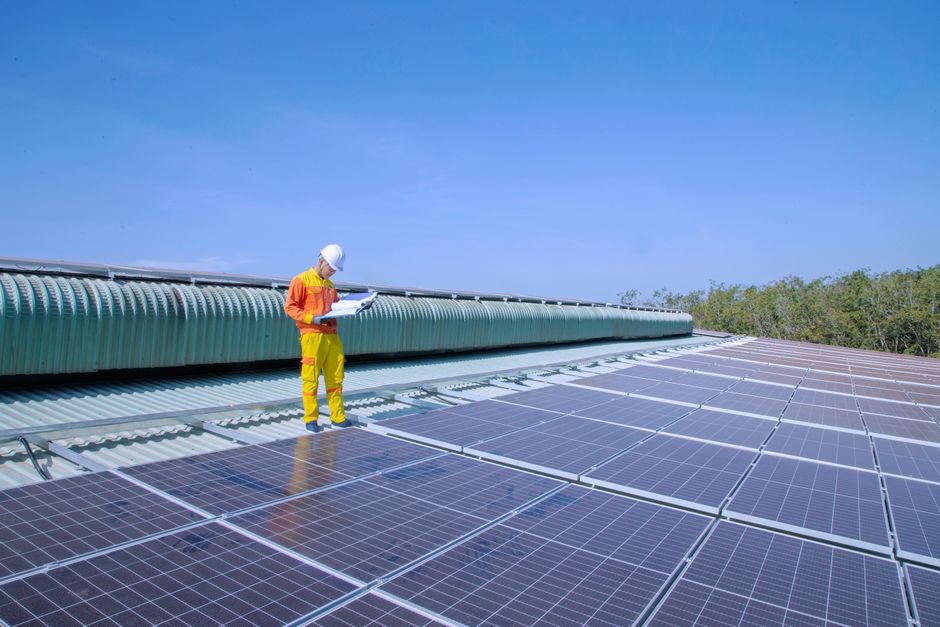
Before you spend thousands of dollars on something, it helps to actually understand how it works — and the good news is that home solar is far simpler than the technical-sounding sales talk makes it seem. Strip away the jargon and a solar system is just a handful of parts moving power around one simple loop. Once you can picture that loop, everything else — sizing, batteries, wiring, standards — is just detail layered on top. Here it is in plain English.
The parts, at a glance
A grid-connected home solar system has only a few components:
- The panels sit on your roof and turn sunlight into direct current (DC) electricity — the same kind a battery makes.
- The inverter converts that DC into alternating current (AC) — the kind your home’s wiring, your appliances, and the national grid all use. It’s the brain of the system.
- Your switchboard (the meter box) distributes the power to wherever it’s needed in the house.
- The meter records how much power you draw from the grid and how much you send back.
- An optional battery stores surplus daytime power for use after dark.
That’s it. Five parts — four without a battery — and they’re all there to serve one simple flow of energy.
The loop, step by step
Here’s what actually happens on a sunny day:
- The sun hits your panels, and they generate DC electricity — more on a bright day, less under cloud.
- The inverter converts it to AC, instantly and continuously, so it’s usable in your home.
- Your house takes what it needs first. Whatever’s running right now — the fridge, the heat pump, the kettle — draws from your solar before anything else.
- Any surplus flows out to the grid (or charges your battery, if you have one). You don’t lose it; your retailer pays you a buy-back rate for it.
- When solar isn’t enough — at night, on a dull day, or when you’re using more than you’re making — you simply draw the difference from the grid, exactly as you did before solar.
It all happens automatically, every second, with no input from you. You won’t notice the system switching between your own power and the grid; the lights just stay on.
The one insight that changes everything
Here’s the single most important thing to understand, because it shapes every other solar decision you’ll make: you stay connected to the grid. Unless you deliberately go fully off-grid (rare, and expensive), solar doesn’t replace your grid connection — it reduces how much power you buy from it.
And there’s a crucial money point hidden in the loop. The power you use yourself as it’s generated saves you the full retail price — around 39c per kWh. The surplus you export earns you far less — often only 7–17c. So the same unit of solar is worth three to five times more if you use it than if you sell it.
That’s why all the good advice boils down to the same thing: use as much of your own generation as you can, while the sun’s up. Run the dishwasher and washing machine in the day, heat your water with surplus solar, charge an EV at midday. Every unit you use yourself is a unit you’re not buying at full price.
What about cloudy days and night-time?
Solar isn’t all-or-nothing. On a cloudy day your panels still produce — just less. At night they produce nothing, and you draw from the grid as normal (or from your battery, if you have one). Across a year, your system quietly covers a large share of your usage and leaves the grid to fill the gaps. You don’t have to manage any of it.
Where a battery fits
A battery is optional, and it slots into the same loop at step 4: instead of exporting your midday surplus at the low rate, you store it and use it in the evening when the panels have stopped. That lifts how much of your own power you use, and many batteries also keep essential circuits running in a power cut (a standard grid-tied system without a battery shuts off in an outage for line-worker safety). It’s an add-on to the loop, not a different system.
The verdict
Home solar is genuinely simple: panels make DC, the inverter turns it into AC, your house uses what it needs, and the surplus goes to the grid or a battery — with the grid quietly filling any gaps. The whole art of owning solar well is just using as much of your own power as you can, because that’s worth far more than exporting it. Everything else you’ll read — sizing, inverter types, wiring, standards — is detail sitting on top of this one loop.
Get a free assessment to see how the loop would work for your home, your roof, and your usage.
Sources: EECA — solar for homes; retail/export price ranges per the Electricity Authority and MBIE. Figures vary by home and retailer.