
Here’s a wrinkle that surprises many people partway through getting solar: your local lines company may cap how much power you’re allowed to send to the grid — or in some cases, not let you export at all. It’s called export limiting, and while it sounds like a dealbreaker, it usually isn’t. But it can affect how you size your system, so it’s worth understanding before you commit. Here’s what’s going on and why.
What export limiting is
When your panels generate more than your home is using, the surplus flows out to the grid. Export limiting is a rule, set by your lines company (the network that owns the poles and wires in your area), that caps how much you can push out — measured in kW. Common forms are:
- A set export cap — for example, you may export up to a certain number of kW, but no more.
- Zero export — in some constrained parts of the network, you may be allowed solar for your own use but not permitted to send any surplus to the grid.
- No limit — many connections have no restriction at all.
The limit (if any) is specific to your address and your local network, and it’s confirmed as part of the grid-connection application your installer submits.
Why lines companies do it
It isn’t arbitrary. The local network was built to send power to homes, not receive large amounts back from thousands of rooftops. In areas where lots of solar already feeds in, or where the local lines are constrained, too much export at once can push local voltages up and stress the network. Export limits are how the lines company keeps the local grid stable and within safe voltage limits. As more homes go solar, these constraints are becoming more common in some areas — though the 2026 reforms are also pushing networks toward accommodating more solar.
How the inverter enforces it
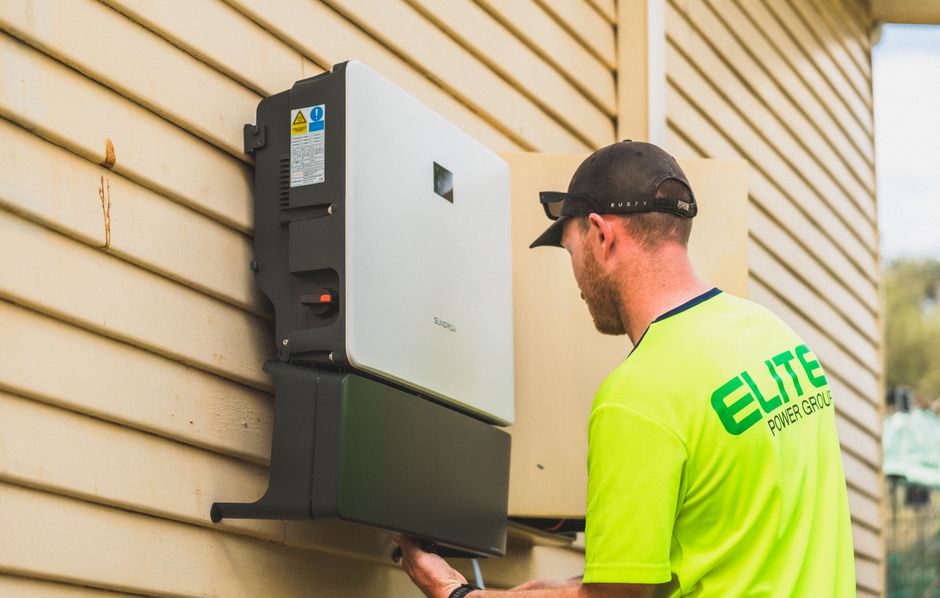
This is the neat part: export limiting is handled automatically by your inverter, with no effort from you. The system monitors how much power is flowing out to the grid and, if you’d exceed your limit, the inverter throttles back its output (or, with a battery, diverts the surplus into storage) so you never breach the cap. You still use all the solar you want inside your home — the limit only applies to what crosses the boundary to the grid. So a limit doesn’t stop you self-consuming; it only caps the surplus.
How it affects sizing
Here’s the practical consequence. If you face a tight export limit (or zero export), a very large system that would otherwise export a lot of surplus loses some of its value — because the inverter will simply curtail the generation it can’t use or export. In that situation:
- A system matched to your daytime self-consumption makes more sense than an oversized one, since the export you’d rely on to justify the extra panels is capped anyway.
- A battery becomes more attractive, because it lets you store surplus you’re not allowed to export and use it yourself later — turning curtailed energy into useful evening power.
In other words, an export limit nudges you toward sizing for self-consumption and, potentially, storage — which, as it happens, is usually the smart strategy anyway given how poorly export pays.
What to do about it
There’s nothing you need to do mechanically — your installer checks your export rules with the lines company as part of the connection application, and configures the inverter to comply. Your job is just to be aware of it, ask your installer what limit applies to your address, and factor it into the sizing conversation. If you’re on a constrained network, design around self-consumption and consider storage rather than betting on big exports.
The verdict
Export limiting is a lines-company cap on how much solar you can send to the grid, set to keep the local network stable; it ranges from no limit, to a set kW cap, to occasional zero-export areas. Your inverter enforces it automatically, throttling output so you never breach the cap — and it only affects exported surplus, never the solar you use yourself. The main impact is on sizing: under a tight limit, favour a system matched to your self-consumption, and consider a battery to capture surplus you can’t export. Ask your installer what applies to your address.
Get a free assessment and we’ll size a system that works within your network’s rules.
Sources: Export-limiting rules and inverter enforcement per lines-company connection requirements and AS/NZS 4777 (grid connection of inverters); network reform context per the Electricity Authority. Limits vary by address and network.